

Securian Financial Home

Coverage Drift™: The hidden risk inside employer life insurance programs

Addressing gaps and uncovering solutions

Coverage Drift is the widening gap between an employee’s life insurance coverage and the financial responsibilities their family depends on today.

Most employers can answer one key question about their company’s group life insurance: how many employees are covered.

Far fewer have clear visibility into whether that coverage still aligns with the lives employees are living.

How Coverage Drift begins

Life insurance is one of the easiest workplace benefits to understand: a coverage amount, a beneficiary, a purpose. Yet Securian Financial’s Affordability Trap research — from employee surveys, HR interviews and broker research — points to a meaningful gap.1

Most employees have some coverage, but fewer have evaluated whether it is enough:

  • 17% of employees have less than the 10 times salary guideline and feel they need more coverage.1
  • 12% are not sure how much coverage they even have.

Coverage Drift happens gradually. A new hire elects employer-paid coverage, often 1 times salary. Then life changes: marriage, a mortgage, children and more. The coverage is still active, and the employee still sees life insurance listed in the benefits portal. But the protection may no longer reflect the financial reality of the household.

Coverage can look stable inside the benefits system long after an employee’s life has moved past the original election.

What causes Coverage Drift?

For years, the group life conversation has leaned heavily on life events. Employees are reminded to revisit coverage after marriage, divorce, childbirth, adoption, a death in the family or a change in employment status.

That message is valid. Life events do trigger reflection.

For life insurance specifically, employees cited the birth of a first child, family that depends on their income, marriage or a serious relationship, the unexpected death of someone close, buying a home and becoming responsible for aging parents as moments that changed their thinking.

7 in 10 employees say a life event shifted which benefits mattered most in the past two to three years.

The bigger challenge often emerges in the years between major life events, as responsibilities accumulate while life insurance coverage remains unchanged.

Life’s progress and growing responsibilities can reshape beneficiary and coverage needs in ways standard enrollment communications may not fully capture.

Naming it Coverage Drift highlights the issue. Participation tells you who enrolled. Alignment tells you whether their coverage still fits.

Coverage Drift

Why active coverage can create false confidence

Life insurance can feel complete once elected. Employees may know they have coverage, but not the amount, assume employer-paid coverage is enough or remember electing supplemental coverage years ago without knowing whether it still reflects their income, dependents or debt.

The same pattern appears in broader benefits decisions. The Affordability Trap research found that two-thirds of employees spent less than an hour on open enrollment, with about 30% spending less than 30 minutes.

When decisions are rushed and abstract, employees often default to shortcuts:

  • Keeping what they had
  • Choosing the lowest-cost option
  • Selecting the middle choice1

Coverage Drift works the same way. The original decision may have made sense once, and nothing appears broken, so it goes unexamined while financial responsibilities outgrow it.

Because coverage is ultimately experienced by a beneficiary, the gap may not become apparent until the moment it matters most.

How employers can identify Coverage Drift

Employers can start by identifying potential gaps, and Secure Insights® can help. This proprietary data analytics solution, developed in partnership with LIMRA, uses industry data, third-party data and client census data to help employers better understand their population, their needs and opportunities to improve the plan experience.

Secure Insights compares employees’ estimated financial needs with existing resources and coverage to help identify potential financial protection gaps across the workforce. Employers and brokers can examine those potential gaps by age, participation patterns, marital status, dependent children, salary and other census-driven indicators.

That creates a more useful view than participation alone. It helps employers move from asking how many employees have coverage to understanding where coverage may no longer align with financial need.

The Coverage Drift audit

Employers and brokers can start with these questions:

  1. Do employees know their current coverage amount, salary multiple and whether they have a beneficiary on file?
  2. Have employees had a meaningful coverage adequacy check-in beyond a yes-or-no enrollment decision?
  3. Which workforce segments appear most exposed to Coverage Drift, such as new parents, caregivers or employees nearing retirement?
  4. Do life-event communications prompt a protection conversation or only an administrative or beneficiary update?
  5. How visible is life insurance outside open enrollment?
  6. Does coverage automatically keep pace with salary changes, or does it require employee action to stay current?
  7. What happens when employees leave, retire or lose eligibility, and do they understand portability or conversion options?

For clients using Secure Insights, these questions can be grounded in population-level analytics rather than anecdote, pinpointing where larger potential gaps exist and where plan design, education or communication may need to adjust.


Example from our Secure Insights report

Insurance gaps

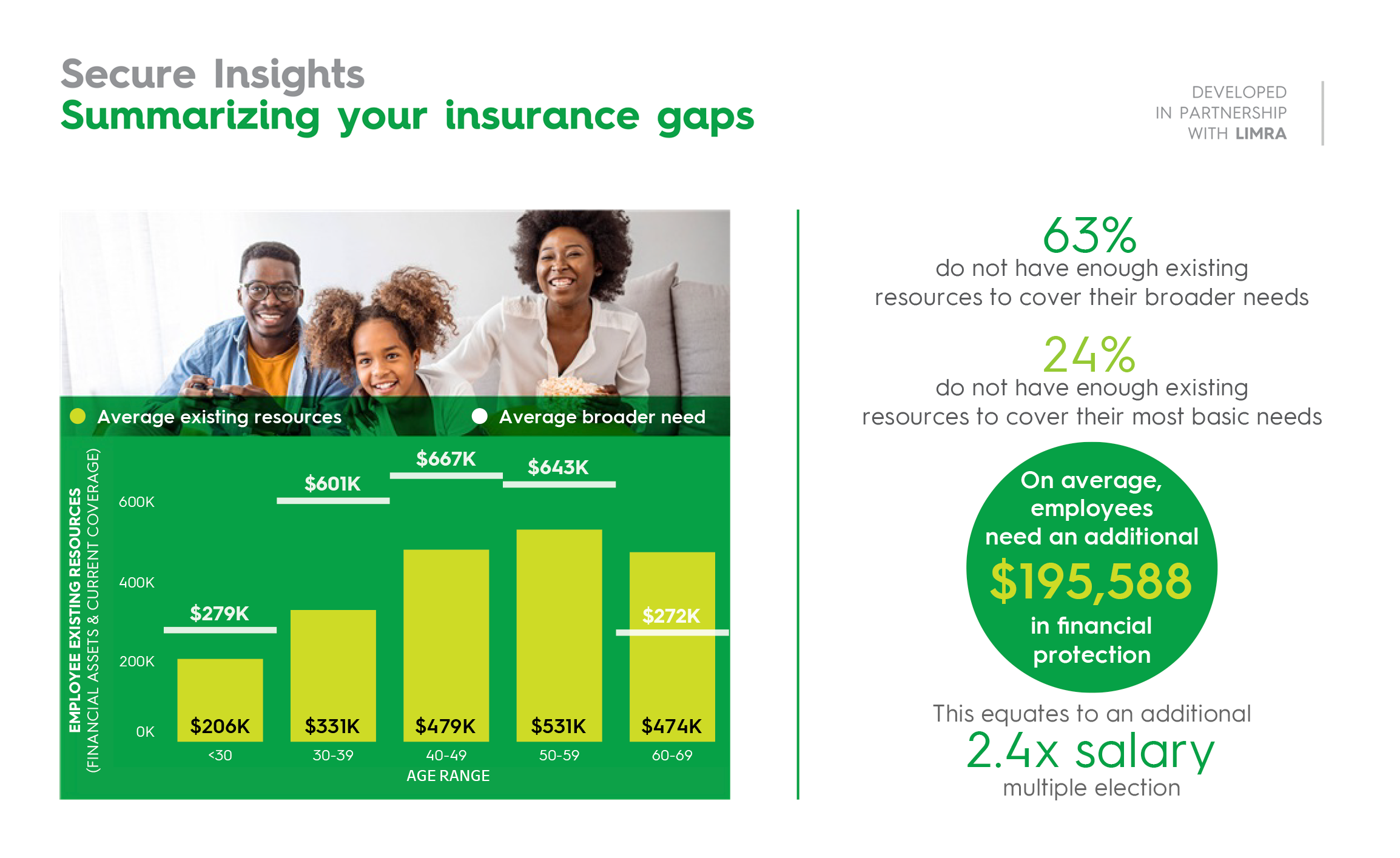
This insight shows the gaps at various age ranges across an employee population. 

In this case, 63% of the population would have a financial gap in the event of a death.  

The space between the average existing resources (vertical bars) and the average product need (horizontal lines) visually depicts the gap in the graph. On average, employees need an additional $195,588 in financial protection.

View a life insurance sample page

Based on employees' existing resources (financial assets and current coverage)

Under 30, $206,00 average existing resources vs a need of $279,000. Ages 30-39, $331,00 average existing resources vs a need of $601,000. Ages 40-49, $479,00 average existing resources vs a need of $667,000. Ages 50-59, $531,00 average existing resources vs a need of $643,000. Ages 60-69, $474,00 average existing resources vs a need of $272,000.

Coverage Drift goes beyond employee education

Communication matters, but Coverage Drift extends beyond awareness.

The group life system is organized around plan events: open enrollment, initial eligibility, guaranteed-issue limits, evidence of insurability, payroll deductions, beneficiary records, portability and conversion windows.

Yet, employees’ lives run on a different clock: family formation, home purchases, caregiving, income dependency, health changes, relationship changes and employment transitions.

Coverage Drift should be considered both a protection strategy and an administration issue. Employers and brokers need to understand whether the plan, platform, communications and processes make it easy for employees to understand, update and confirm their coverage when it counts.

From offering coverage to maintaining protection

Coverage Drift recognizes a simple reality: workforces, households and benefits expectations change over time.

For brokers, that opens a more strategic client conversation rooted in workforce financial resilience rather than rate, plan design and participation alone.

For employers, it reframes life insurance as something to maintain year-round rather than a static annual election.

Securian Financial helps clients take the next step through Secure Insights, using data to identify potential gaps, understand which segments may need more support and inform more relevant plan design, education and communication.

The shift is straightforward in principle. Employers and brokers can take action to close the gap with:

  • Year-round coverage conversations
  • Life-event prompts that lead to better decisions
  • Beneficiary records kept current
  • Messaging timed to the moments employees are most ready to act

The most useful question an employer or broker can ask is also the simplest: How much Coverage Drift exists in our workforce today?

Those who can answer it are better positioned to protect employees, support families and demonstrate the value of life insurance within a modern benefits strategy.

Secure Insights®

Helps you identify Coverage Drift across your workforce, understand the gaps and take action to strengthen financial protection for your workforce when it matters most.

Learn more
Email

Subscribe to Snapshot

Receive relevant information monthly.

Sign up

All statistics cited are from Securian Financial’s fourth annual study: The Affordability Trap, 2026.

Insurance products are issued by Minnesota Life Insurance Company or Securian Life Insurance Company, a New York authorized insurer. Minnesota Life is not an authorized New York insurer and does not do insurance business in New York. Both companies are headquartered in St. Paul, MN. Product availability and features may vary by state. Each insurer is solely responsible for the financial obligations under the policies or contracts it issues.

Securian Financial is the marketing name for Securian Financial Group, Inc. and its subsidiaries. Minnesota Life Insurance Company and Securian Life Insurance Company are subsidiaries of Securian Financial Group, Inc.

DOFU 9-2026

5717377