


Trust under pressure: 4 barriers stalling payment protection adoption
Financial wellness used to mean getting ahead — growing assets, hitting milestones, building wealth. For today's borrowers, it means something more urgent: staying afloat.

Rising costs, sustained economic pressures, and fear of the unknown have shifted borrowers from financial offense to financial defense. In this environment, solutions like payment protection should be an easy yes. They're not.

Drawing on our quantitative survey of 1,000 current and potential borrowers and in-depth interviews with key credit union and banking leaders, our third annual lending environment study reveals why: a trust gap is quietly stalling adoption - even among borrowers who believe in the product value.
The borrower trust framework
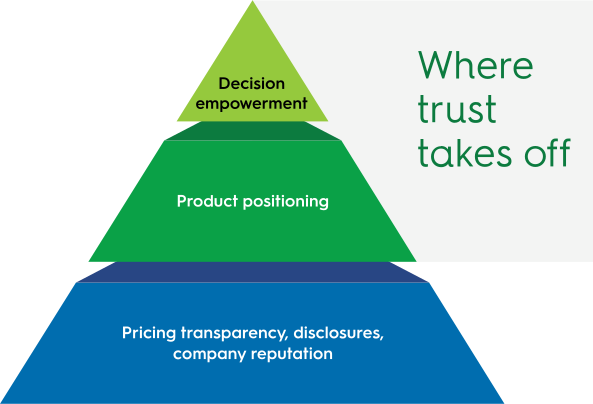
Most lenders lean solely on pricing transparency, disclosures and company reputation to build credibility. These things absolutely matter, in fact, they're critical in establishing trust. And while important, these things alone don't necessarily build conviction.
Lasting trust, which turns borrowers into advocates, is built with the foundation plus experience — how the product is positioned, how the conversation feels and whether the borrower walks away feeling empowered or sold.The cost of inaction isn't just less adoption. It's borrowers who face hardship without a safety net, lenders who lose loyalty at the moment of greatest need and an industry that continues to rely on facts alone to build trust.
Four trust barriers
Product positioning: Understanding and urgency

Borrowers don’t trust what they fully don’t understand
Most borrowers have heard of payment protection, but familiarity isn't the same as comprehension. Many confuse it with payment deferral or loan extensions, rather than a product that cancels payments or balances during qualifying hardships.
The result is a dual perception: borrowers see the value in concept, but distrust how it's positioned in practice.

Borrowers don’t act on risks they don’t feel
Half of borrowers are one disruption away from financial strain. Younger borrowers are especially exposed: they report the highest worry about job loss and rising expenses, paired with inflated confidence in their ability to weather it. The "what if" is real. The urgency to act on it is not.
40%
of borrowers say they’re familiar with loan payment protection
77%
perceive it provides meaningful financial security
33%
still describe it as feeling like a junk fee
50%
of borrowers could sustain payments for only 3 months or less if they lost their income
31%
of U.S. households are considered financially healthy
1 in 5
borrowers have purchased loan protection
Closing the trust gap on product positioning:
What lenders can do
Don’t assume that borrower confidence equals financial preparedness.
Educate borrowers early in the loan process. Clearly state the cost, loan terms and real-life examples of how it works.
Showcase how your institution shows up in time of hardship. Highlight number of claims paid, testimonials and stories about how protection solutions impact borrowers.
Decision empowerment: Control and channel

Borrowers don’t trust decisions they feel they didn’t make
How payment protection is offered matters as much as how it's described. When it's bolted on at the end of a loan conversation, borrowers read it as a sales tactic, not a service. When it's presented as a clear, optional, borrower-controlled choice, trust climbs sharply. Trust erodes the moment borrowers feel caught off guard.
85%
of borrowers believe lenders should help them prepare for financial hardships
48%
perceive payment protection as a way for lenders to make money
32%
say simply having the clear option to decline the product builds trust

Borrowers don’t trust experiences that don’t meet them where they are
Human conversations build a sense of security: borrowers can ask questions, get real-time answers and feel understood. Digital experiences offer something different but equally valued: independence, time to research and freedom from sales pressure. Neither channel wins outright. What wins is clarity of choice in whichever channel the borrower is in.
Closing the trust gap on decision empowerment:
What lenders can do
Consider decision support tools for borrowers to see the impact of an unexpected expense.
Train loan officers on fact-finding exercises to help make payment protection real for borrowers.
Create hybrid experiences that combine digital independence and support. This could mean seamless transitions between both experiences, human assistance embedded into digital journeys and visible, borrower-controlled decision points.

Generational differences - additional things to consider
Trust is built on experience and no two generations experience payment protection the same way. The most striking finding isn’t that generations differ. It's that the generations who need protection the most are the least likely to trust it, and the generations most willing to buy it are the least likely to understand what they’re buying.
Gen Z: Open, but operating on incomplete information
Gen Z borrowers purchase loan protection at the highest rate of any generation, but a third say the product is confusing. They're buying on faith, not fluency. For lenders, that's a short-term win and a long-term trust liability: a borrower who doesn't understand what they bought is a borrower who feels misled at claim time.
31%
of Gen Z have purchased loan protection
33%
of Gen Z say protection is confusing
Boomers: Skeptical and the hardest to win
Boomers buy loan protection at half the rate of Gen Z — and more than half believe the product exists primarily to make money for lenders. This is the generation most likely to face health-related income disruption, and the least likely to accept protection as a solution. Skepticism here isn't solved with disclosures. It's solved with proof.
15%
of Boomers have purchased protection
51%
of Boomers agree that the product is a way for lenders to make money
Closing the trust gap across generations:
What lenders can do
Tailor the conversation, not just the channel. Gen Z needs plain-language education and visual explainers built into digital journeys. Boomers need claims data, testimonials and named examples of borrowers like them who were helped.
Audit your loan officer training for generational fluency. The same script doesn't build trust with a 24-year-old first-time borrower and a 64-year-old refinancing a mortgage.
Measure trust outcomes by generation, not just adoption. A high Gen Z purchase rate paired with a high Gen Z confusion rate is a future complaint, not a current win.
Trust is the new adoption strategy
The borrowers who most need payment protection are the least prepared to trust it: borrowers who believe in the value but don't understand the product, who recognize their vulnerability but don't act on it, who want guidance but read offers as sales tactics, who want support but only on their own terms.
The lenders who close this trust divide will rethink how protection is positioned, how decisions are offered and how every borrower walks away informed and in control. Trust isn't built at the point of sale — it's built across every interaction that leads to it, and every one that follows.
Start a conversation
Learn more about how you can grow your business and help protect your customers. Contact our sales team to get started.
Related articles

Helping borrowers prepare for the unexpected
Payment protection helps support a borrower’s financial well-being, reduce defaults, and generate non-interest income to enhance your bottom line. This suite of products supports our lending solutions and includes credit insurance and debt protection.

See more research
See more research conducted by Securian Financial, including data on family-building benefits and caregivers in the workplace.
All statistics are from Securian Financial’s 2026 3rd annual research study, Beyond Protection: Building Trust through Lender Support. Survey participants were compensated for their participation and testimonials. The testimonials were given freely.
Payment protection refers to our suite of products that support lending solutions sold through financial institutions. These products include debt protection and credit insurance.
DOFU 6-2026
5505248